Memory Twin Framework

Running commentary

My field notes

These notes are my own. I write them as a PhD fellow researching the Memory Twin Framework, tracking published papers, conference proceedings and news in cultural heritage documentation, paradata and 3D digitisation, and setting out my own position on what each means for the framework.

I am Anthony Cassar. The views here are personal interpretations and observations, not those of any institution.

First page of the Europeana periodic report M45 for the common European data space for cultural heritage

03 · August 2026

Permitted, Not Yet Measured: Paradata in the Data Space

On Management team and Julia Schellenberg, Europeana Foundation (2026). CNECT/LUX/2021/OP/0070, European Commission.

Europeana's latest periodic report for the common European data space records a genuine milestone: the EDM schema and Metis pipeline now carry metadata and paradata at source, and a provenance workflow stamps records with the activities applied to them. As a national aggregator I welcome this, but I would say plainly that without certified paradata, a 3D acquisition is a picture of a thing rather than evidence about it. Paradata is now permitted by the infrastructure. It is not yet measured by it, and the quality frameworks score a record with full capture documentation exactly as they score one with none. The next step is a quality framework that can tell the difference.
Read more

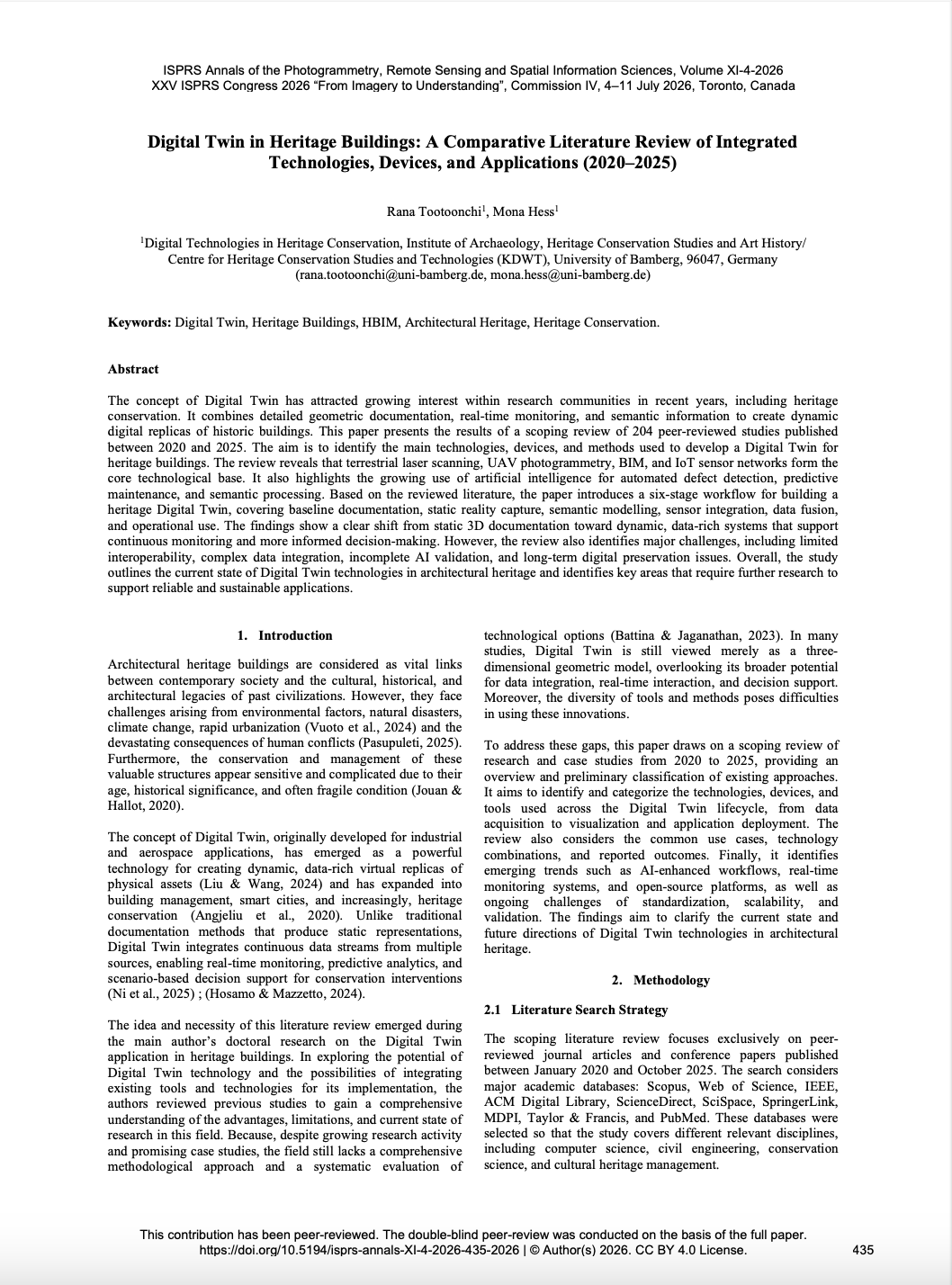
First page of the ISPRS Annals article Digital Twin in Heritage Buildings: A Comparative Literature Review of Integrated Technologies, Devices, and Applications (2020–2025)

02 · August 2026

Being Excluded Is a Kind of Recognition

On Tootoonchi, R., & Hess, M. (2026). ISPRS Annals of the Photogrammetry, Remote Sensing and Spatial Information Sciences, Volume XI-4-2026, 435–442.

A new ISPRS Annals scoping review by Tootoonchi and Hess maps 204 studies onto a six-stage workflow for Heritage Digital Twins, from baseline documentation through to operational lifecycle. Buried in its methodology is a line I did not expect: Memory Twins were explicitly excluded as out of scope. Absence from a literature review reads as immaturity; deliberate exclusion is a boundary drawn by someone else. The paper is careful, useful, and read closely, a map of exactly where the Digital Twin model terminates and the interpretive layer goes missing.

Read more

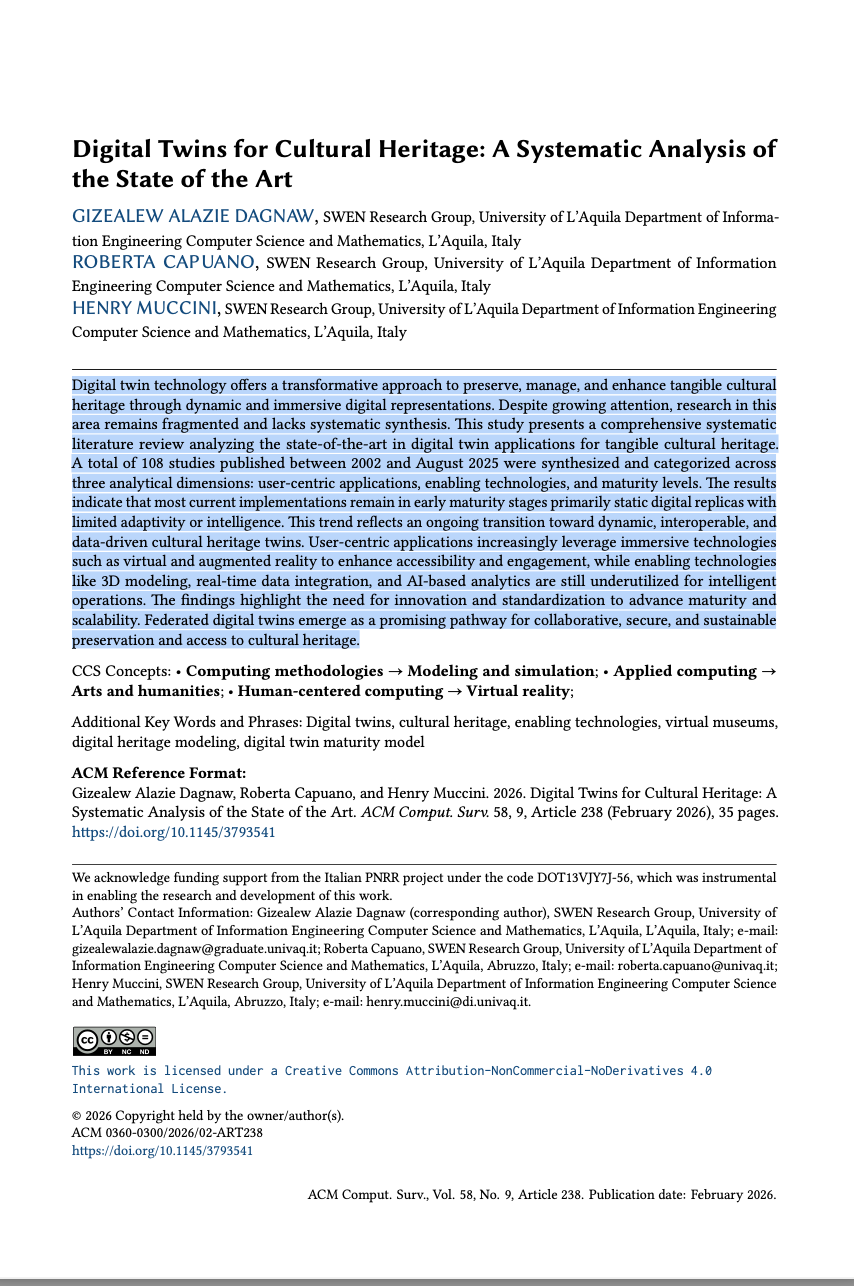
First page of the ACM Computing Surveys article Digital Twins for Cultural Heritage: A Systematic Analysis of the State of the Art

01 · August 2026

Positioning the Memory Twin against the state of the art

On Dagnaw, G. A., Capuano, R., & Muccini, H. (2026). ACM Computing Surveys, 58(9), Article 238, 35 pages.

A systematic review of 108 studies finds that most heritage digital twins remain at pre-DT or basic DT maturity, with metadata and technical data present in only around a fifth of implementations. The paper identifies the neglect of contextual information, oral histories and intangible heritage as an open challenge for the field. The field's own state-of-the-art review concludes that current implementations privilege geometric and structural data at the expense of cultural significance.

Read more