Running commentary · August 2026
Being Excluded Is a Kind of Recognition
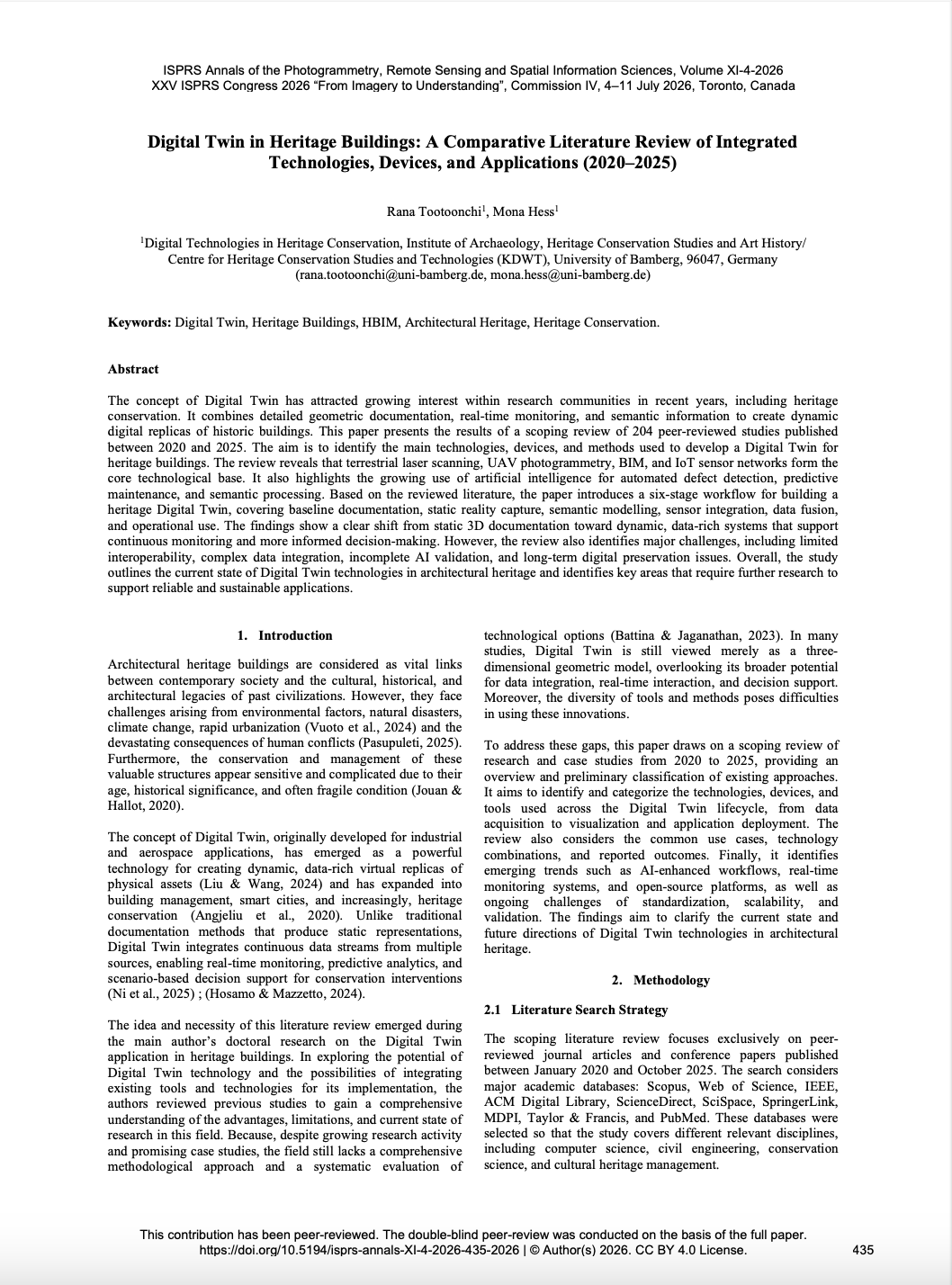
The paper
Tootoonchi, R., & Hess, M. (2026). Digital Twin in Heritage Buildings: A Comparative Literature Review of Integrated Technologies, Devices, and Applications (2020–2025). ISPRS Annals of the Photogrammetry, Remote Sensing and Spatial Information Sciences, Volume XI-4-2026, 435–442.
There is a single sentence in the methodology of the new ISPRS Annals scoping review that I did not expect to find. Screening 564 publications down to 204, Rana Tootoonchi and Mona Hess record that studies on Memory Twins and Ambient Twins were excluded, as their focus fell outside the scope of the review.
I have spent a good part of this doctorate arguing that the Memory Twin is a distinct construct rather than a Digital Twin with extra adjectives. It is a curious feeling to have that argument made, in passing, by someone else's inclusion criteria. Absence from a literature review can always be read as immaturity. Deliberate exclusion is something different: it is a boundary drawn by a third party, in a peer-reviewed venue, in 2026.
The paper itself is a careful piece of work and belongs high on any heritage digitisation reading list. Its central contribution is a six-stage workflow, baseline documentation, static reality capture, semantic HBIM modelling, sensor integration, data fusion, operational lifecycle, and it is the clearest articulation I have seen of what a functioning Heritage Digital Twin actually requires.
It is also, read closely, a map of where that model terminates.
Stage one is the revealing one. Archival drawings, restoration reports, narratives and diagnostic files are gathered into what the authors call a reference base, then organised in cataloguing systems and GIS. The sources are ingested. How they were read, by whom, on what evidential warrant, and with what confidence, none of this is carried forward. The interpretive act that produced the model leaves no trace in the model. Stage six, correspondingly, ends in maintenance logs, rescanning and sensor calibration: the twin as long-term companion to the building.
The authors are alert to the fragmentation. Their keyword analysis shows the cluster containing site, user, visitor and collaboration only loosely tethered to the technical clusters; intangible and socially oriented cases account for five per cent of their case-study typologies. Their diagnosis is that we need more accessible, user-friendly platforms.
I would put it differently. This is not an interface deficit. It is a missing knowledge layer; paradata, interpretation, intangible practice, community memory, certified provenance and no amount of usability work will supply it.
Which is, I think, precisely what got excluded.
This is a personal reading by Anthony Cassar, PhD research fellow on the Memory Twin Framework. The views expressed are my own.