Running commentary · September 2026
Beyond the Model: Why I Stopped Treating Digitisation as the Finish Line
Watch the presentation
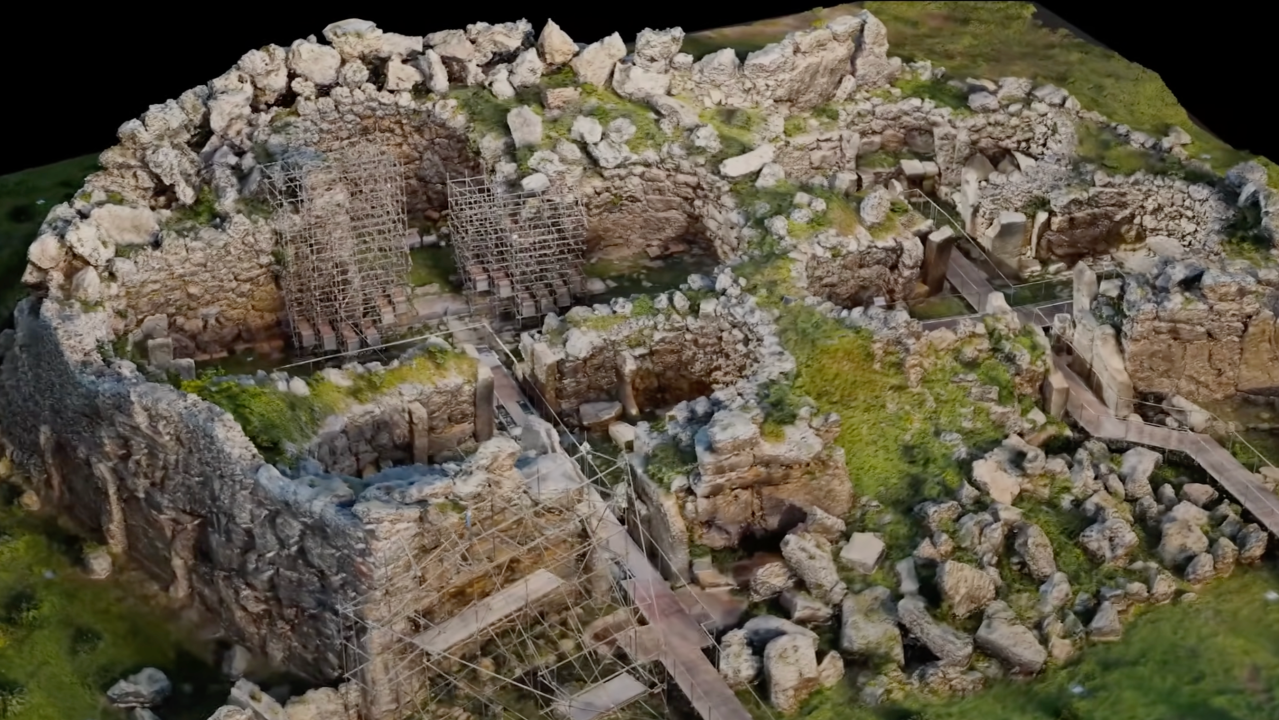
Beyond 3D Models: Creating a Memory Twin for Malta's Ġgantija Archaeological Park
Anthony Cassar and Andrew Pace present the Ġgantija case study at the MuseumNext Digital Collections Summit 2026. The video begins at their presentation.
The paper
Cassar, A. (2026). Beyond the Model: Why I Stopped Treating Digitisation as the Finish Line. LinkedIn, 25 September 2026.
Reflections on presenting the Ġgantija Memory Twin at MuseumNext 2026, and on the research journey behind it.
What if a 3D model could preserve not just a monument, but everything we know about it?
That question sat at the heart of the presentation my colleague Andrew Pace and I delivered at the MuseumNext Digital Collections Summit 2026: "Beyond 3D Models: Creating a Memory Twin for Malta's Ġgantija Archaeological Park." More than 1,450 participants joined online from 34 countries, and the programme was full of thoughtful, practical work on where digital collections are heading. It was a privilege to share that space with so many people pushing the sector forward.
For me, though, this was more than another conference slot. It was a chance to bring together, in a single case study, the ideas that have shaped my doctoral research over the past years, and to put them in front of the people who work with digital collections every day. So I want to use this article to step back and explain where the Memory Twin came from, and why I believe it matters.
Where this started
I have spent much of my career between two worlds: cultural heritage and digital technology. Through my work at Heritage Malta, leading the Technology and Experience Development Unit, I have seen extraordinary 3D documentation produced of sites and objects that define who we are as Maltese.
And yet, over time, something kept bothering me.
The turning point came with the digitisation of the Malta Dockyard collection. As we began to document not only the objects, but the intangible heritage around them, the skills, the working practices and the memories of those who worked there, my way of seeing changed completely. A tool was no longer just a tool; it was part of a trade, a community and a way of life. And the Dockyard itself stopped being a collection of artefacts and became what it truly is: an industry that shaped generations of Maltese families and an essential chapter in our national history.
That experience crystallised a simple realisation. We had become very good at capturing the shape of heritage, and far less good at capturing the knowledge and memory around it. Without that knowledge, a digitised object can survive while its meaning quietly disappears.
The problem is not the model. It is the missing context.
Every act of documentation involves decisions: which instrument was used, under what conditions, what was included and left out, how gaps were interpreted. This information, known as paradata, is what allows a record to be trusted and reused decades later. It is also what we most often lose.
This is not a Maltese problem; it is a sector-wide one. Through the HERITALISE Horizon Europe project, a survey of 423 respondents across 97 countries pointed consistently to fragmentation and the absence of paradata as persistent challenges in digital heritage practice.
At Heritage Malta, we set out to do things differently. The digitisation of the Ġgantija Neolithic complex was built on detailed paradata collection, following the methodology of the European Commission's VIGIE 2020/654 study on quality in 3D digitisation of tangible cultural heritage, under the guidance of the UNESCO Chair on Digital Cultural Heritage. Every stage of the process was documented alongside the model itself, so that future researchers can understand not only what was captured, but how and why. That foundation is what made Ġgantija the right place to take the next step towards a Memory Twin.
None of this is possible without the right infrastructure underneath. Within the agency, my colleague Andrew Pace leads our collections management system, which sits at the core of how we organise digitised heritage and how we share it with Europeana as Malta's national aggregator. That system is where knowledge either stays connected or quietly falls apart, which is why it has been central to the Memory Twin work from the start.
From 3D to Memory Twin
A 3D digital model mirrors the physical state of something. A Memory Twin extends that idea. It treats the 3D model not as the end product, but as a spatial anchor to which we connect everything we know: archaeology, conservation records, research findings, oral histories, interpretation, and cultural memory. Crucially, it records how that knowledge was produced and how reliable each piece of it is. The difference is between preserving an object and preserving an understanding.
Why Ġgantija
Ġgantija, in Gozo, is part of the UNESCO World Heritage listing of the Megalithic Temples of Malta, and among the oldest free-standing monumental structures in the world. It carries well over a century of excavation, interpretation, conservation and debate. If any site demonstrates why knowledge fragments over time, it is this one.
For the case study, we built a knowledge graph that brings together data from across Heritage Malta and beyond: curatorial records, academic scholarship, research findings and intangible heritage, alongside the 3D documentation and its paradata. Rather than sitting in separate departments and systems, these sources are connected around the monument itself, together with the people who studied it and the claims they made. The graph is structured through multiple layers of knowledge, with CIDOC-CRM, the international reference model for cultural heritage information, as one of them, ensuring that what we build remains interoperable with the wider heritage sector. The result is a single, connected and queryable environment in which decades of knowledge about Ġgantija can finally be read together.
What this makes possible
When a digital model carries its knowledge with it, it becomes useful far beyond visualisation. It can support long-term knowledge preservation, research and scholarly collaboration, conservation planning and monitoring, visitor engagement and interpretation, and future immersive experiences that are grounded in evidence rather than guesswork.
That last point matters to me. As AI, knowledge graphs and spatial computing mature, there will be enormous pressure to produce engaging heritage experiences quickly. Without structured, trustworthy knowledge underneath, those experiences risk becoming attractive but hollow. A Memory Twin is, in part, a safeguard: it keeps the story tied to the evidence.
What this journey has taught me
If I had to put the lesson in one line, it would be this: digitisation is not the finish line. It is the foundation. The real work, and the real responsibility, lies in what we build on top of it.
The research continues. The Ġgantija case study sits alongside the Dockyard work that started it all, now a central focus of my thesis, as well as the Cypriot case studies of Lambousa and Fikardou developed with colleagues at the Cyprus University of Technology. Each one tests the framework against a different kind of heritage and a different kind of memory but all aimed at preserving it in its most complete and authentic way.
Thank you
My sincere thanks to MuseumNext for including the framework in this year's programme; to Andrew Pace, who not only co-presented with me but leads Heritage Malta's collections management system, the backbone of how we organise our digitised heritage and connect it to Europeana; to Prof. Marinos Ioannides, UNESCO Chair on Digital Cultural Heritage at the Cyprus University of Technology, for mentoring me throughout this research; and to the Heritage Malta team, whose dedication made the Ġgantija Memory Twin possible.
I would genuinely like to hear from colleagues working on similar questions. How is your institution capturing the knowledge behind its digital assets, not just the assets themselves?
#MemoryTwin #DigitalHeritage #CulturalHeritage #3DDigitisation #Paradata #HeritageMalta #Ġgantija #MuseumNext #DigitalCollections #UNESCO #KnowledgeGraphs
This is a personal reading by Anthony Cassar, PhD research fellow on the Memory Twin Framework. The views expressed are my own.