Running commentary · August 2026
Positioning the Memory Twin against the state of the art
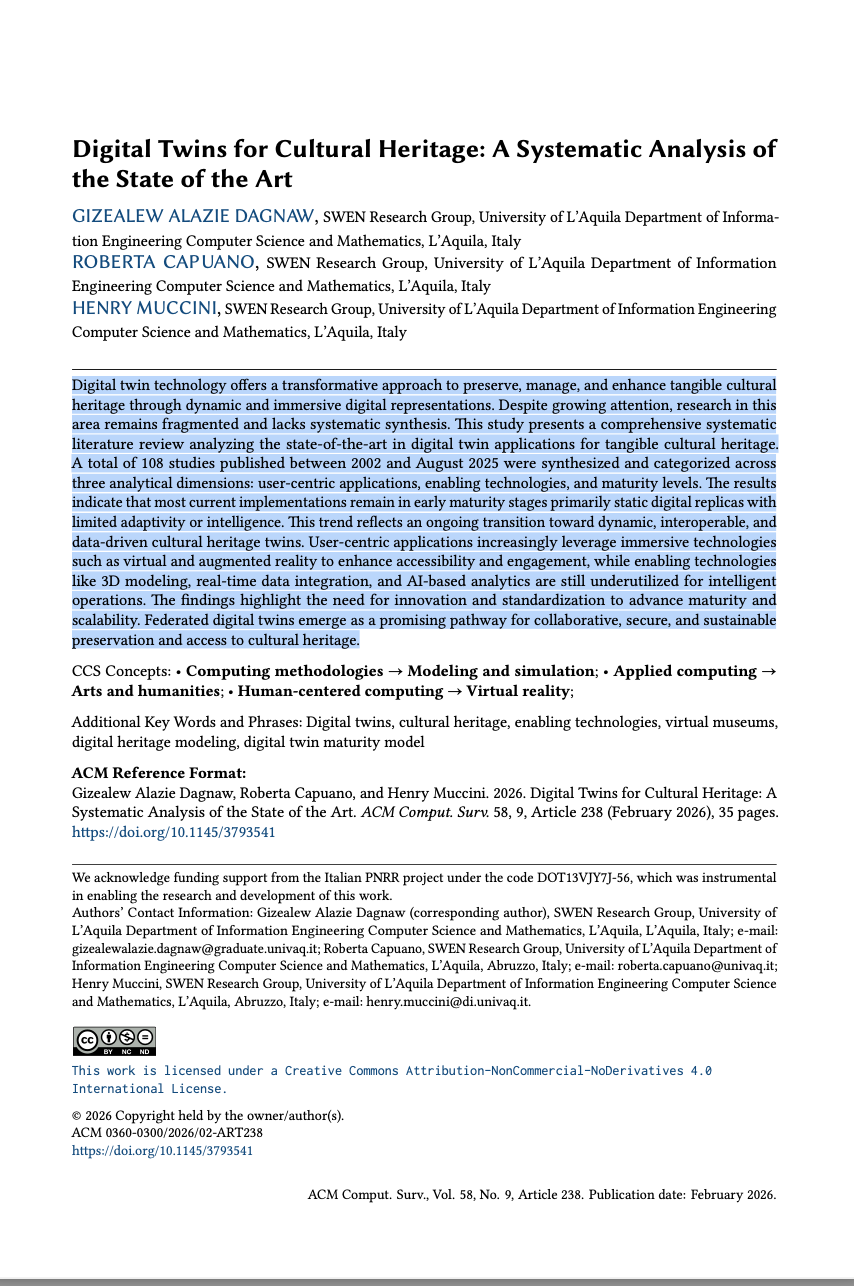
The paper
Dagnaw, G. A., Capuano, R., & Muccini, H. (2026). Digital Twins for Cultural Heritage: A Systematic Analysis of the State of the Art. ACM Computing Surveys, 58(9), Article 238, 35 pages.
A systematic review of 108 studies published between 2002 and August 2025 finds that most heritage digital twins remain at pre-DT or basic DT maturity, with metadata and technical data present in only around a fifth of implementations. The authors identify the neglect of contextual information, oral histories and intangible heritage as an open challenge for the field. In other words, the field's own state-of-the-art review concludes that current implementations privilege geometric and structural data at the expense of cultural significance.
This matters because the diagnosis comes from outside the Memory Twin Framework rather than from within it. The review is not arguing for a particular methodology; it is counting what has actually been built. What it counts is an accumulation of static replicas, accurate, expensive, and largely mute about why the recorded fabric was considered worth recording at all. Adaptivity, interoperability and data-driven behaviour, the properties that make a digital twin a twin rather than a model, are still aspirations in most of the corpus.
The Memory Twin Framework is a direct response to precisely this gap. Where the review reports that metadata appears in roughly one in five implementations, the framework treats metadata and paradata as constitutive rather than supplementary: the reasoning, provenance, uncertainty and interpretive decisions behind a record are part of the heritage asset, not documentation overhead attached to it. Where the review flags intangible heritage and oral testimony as unresolved, the framework builds them into the same documentation workflow as the survey data, instead of parallel to it.
Read alongside the framework literature, this review functions as an independent baseline. It establishes that the problem the Memory Twin Framework names is measurable and widely distributed, not a rhetorical position. It also sets a fair test: any claim that the framework advances the state of the art should be demonstrable against the same maturity dimensions the review uses, namely user-centric application, enabling technology, and maturity level, rather than against its own vocabulary.
The review's closing suggestion, that federated digital twins offer a route to collaborative, secure and sustainable preservation, is compatible with the framework's insistence on FAIR and CARE handling of heritage records. Federation without paradata, however, would simply distribute the same silence at greater scale. The interesting work lies in federating the interpretation as well as the geometry.
This is a personal reading by Anthony Cassar, PhD research fellow on the Memory Twin Framework. The views expressed are my own.