Memory Twin

Research

The Memory Twin in the literature

Six peer-reviewed works by Anthony Cassar, Marinos Ioannides and colleagues trace the Memory Twin framework from its first formulation to its use in cultural heritage documentation, ethical digitisation and sustainable cultural tourism.

01

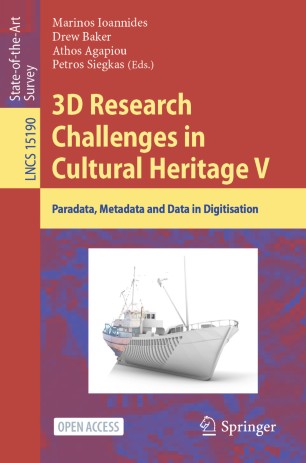
Integrating Paradata, Metadata, and Data for an Effective Memory Twin in the Field of Digital Cultural Heritage

Ioannides, M., Karittevli, E., Panayiotou, P., & Baker, D. (2024). 3D Research Challenges in Cultural Heritage V, LNCS 15190, pp. 24–35.

The earliest major peer-reviewed publication to explicitly formulate the Memory Twin. It argues that a faithful geometric replica of a monument, however precise, records only its surface: what a culture actually remembers lives in the reasoning, provenance and interpretation that surround the record. The paper therefore proposes three interdependent layers — data, metadata and paradata — as the minimum architecture for a heritage twin that can be understood, questioned and reused decades after its creation. Working through the Cypriot cases of Lambousa and Fikardou, the authors trace the shift from physical replication toward contextual representation, showing how documentation decisions, uncertainties and interpretive choices become part of the heritage asset itself. Authenticity, interpretation and long-term accessibility emerge as the central benefits of this approach. It should generally be cited as the foundational Memory Twin publication and the reference point for all later developments of the framework.
DOI 10.1007/978-3-031-78590-0_3

02

From Digital Twin to Memory Twin: A Holistic Framework for Cultural Heritage Documentation, Interpretation, and Adaptive Reuse

Cassar, A., Baker, D., & Ioannides, M. (2025). The International Archives of the Photogrammetry, Remote Sensing and Spatial Information Sciences, XLVIII-M-9-2025, pp. 203–209.

The principal statement of the Memory Twin framework in its current form. Where the digital twin models a building's measurable state, the Memory Twin binds that geometry to the narrative, emotional and community memory that make a place meaningful, treating tangible and intangible heritage as a single documentation problem rather than two parallel workflows. The paper sets out a multidisciplinary methodology spanning survey, archival research, oral testimony and heritage HBIM, and demonstrates it through a detailed case study of Villa Portelli in Malta, a building whose layered occupation histories resist purely geometrical description. Adaptive reuse is treated not as an afterthought but as the point at which memory either survives or is lost, so the framework is designed to carry interpretive evidence forward into future intervention decisions. Open access and already widely cited, this is the reference for anyone implementing rather than merely citing the Memory Twin.

DOI 10.5194/isprs-archives-XLVIII-M-9-2025-203-2025

03

Paradata, Metadata, and Data in the Digitisation of Cultural Heritage: A Memory Twin Perspective

Cassar, A. (2025). 3D Research Challenges in Cultural Heritage VI: DigitalTwin versus MemoryTwin, LNCS 15930, pp. 1–14.

A theoretical bridge between the original Memory Twin formulation and the emerging question of what artificial intelligence should be allowed to learn from heritage records. The chapter examines the movement from data-centred to memory-enriched digitisation and identifies context loss as the defining failure mode of large-scale digitisation programmes: files survive, while the reasoning that produced them quietly disappears. It proposes certification of metadata and paradata as a practical remedy, making transparency and reproducibility auditable properties of a heritage dataset rather than professional courtesies. The discussion extends to the ethical risks of AI systems trained on decontextualised cultural material, and argues for participatory, interdisciplinary governance in which communities retain a voice over how their memory is encoded. Heritage Malta's digitisation experience grounds the argument in operational practice. It is among the strongest conceptual foundations for paradata-driven, ethically accountable heritage AI.

DOI 10.1007/978-3-032-05656-6_1

04

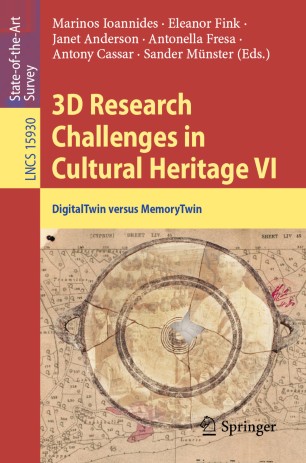
3D Research Challenges in Cultural Heritage VI: DigitalTwin versus MemoryTwin

Ioannides, M., Fink, E., Anderson, J., Fresa, A., Cassar, A., & Münster, S. (eds.) (2025). Springer, Lecture Notes in Computer Science 15930.

The first major scholarly volume built explicitly around the transition from Digital Twin to Memory Twin, and best presented as a key reference collection rather than another edited proceedings book. Across its chapters the volume assembles the technical, ethical and archival arguments the framework depends on. Cassar sets out the Memory Twin perspective on paradata; Huvila examines how paradata is actually generated, by asking questions or telling stories; Haynes addresses IIIF 3D and the sustainability of digital heritage infrastructure; Münster interrogates documentation and scientificity in the age of generative AI; Eide develops the Memory Viewer and its Semantic Web underpinnings; Anderson and colleagues confront the long-term preservation of 3D models; and Bajena proposes core data models for metadata and paradata. Contributions from the HERITALISE and EUreka3D projects connect the discussion to European infrastructure, making the volume the field's current point of departure.

DOI 10.1007/978-3-032-05656-6

05

Beyond Digital Twins: Introducing the Memory Twin for Cultural Heritage

Ioannides, M., Karittevli, E., Panayiotou, P., & Baker, D. (2025). EVA Berlin 2025: Electronic Media and Visual Arts, pp. 91–97.

A concise and deliberately accessible formulation of the Memory Twin, written for an audience of media practitioners and visual arts specialists rather than documentation scientists. The paper reconstructs the concept from first principles across five dimensions: the physical attributes of the heritage asset; its historical context; the tripartite structure of data, metadata and paradata; the relationship between tangible fabric and intangible practice; and the interactive, immersive forms through which a twin is finally encountered by an audience. Its value lies partly in the clarity of that synthesis and partly in where it appears. By restating the framework outside the original Springer series, it demonstrates that Memory Twin has begun circulating as a shared concept across independent scholarly venues rather than remaining the property of a single publication lineage. It is a useful entry point for readers approaching the framework for the first time.

DOI 10.11588/arthistoricum.1568.c24046

06

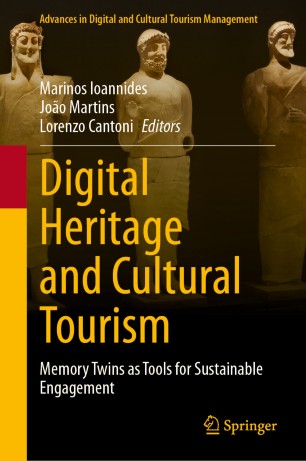
Memory Twin and Cultural Heritage Tourism

Cassar, A. (2026). Digital Heritage and Cultural Tourism: Memory Twins as Tools for Sustainable Engagement, pp. 23–37.

This chapter carries the framework out of the documentation studio and into the visitor experience, asking what a Memory Twin changes for the person standing in the room. It operationalises the concept through three testable criteria: a tripartite data architecture, structured integration of intangible heritage, and compliance with both FAIR and CARE principles, the latter ensuring that community authority over cultural memory is respected rather than assumed. Heritage Malta productions including An Island at the Crossroads and Betrayal and Vengeance serve as working cases, showing how oral history and multisensory interpretation can be delivered as part of a sustainable tourism offer rather than as supplementary content. The chapter is currently the strongest published link between Memory Twin and emotional engagement, reuse of already digitised resources, visitor-carrying capacity, and the protection of intangible heritage that is vulnerable precisely because it is performed rather than built.

DOI 10.1007/978-3-032-22974-8_2